How can I protect our deposit for a lithium manganese battery order?
- VIP-User
- 2026-10-02
- 1
Protecting your deposit for a lithium manganese battery order requires partnering with certified manufacturers that enforce stringent quality protocols. Selecting suppliers with ISO 9001, IATF 16949, and UL certifications ensures compliance. Verifying standardized production workflows—including incoming raw material inspection, 100% production line inspection, and clear contractual milestones like 30-day delivery timelines—mitigates financial and operational risks effectively.
Core Solutions & Key Takeaways
- Work exclusively with accredited manufacturers holding ISO 9001:2015, IATF 16949:2016, and UL safety certifications for lithium batteries.
- Establish defined commercial parameters, including a 30-day delivery timeline and a Minimum Order Quantity (MOQ) of 10,000 units.
- Mandate comprehensive quality verification covering incoming raw material inspection, 100% production line inspection, and laboratory sampling.
- Leverage suppliers with Authorized Economic Operator (AEO) customs status to ensure smooth international transport via sea freight shipping.
Detailed Architectural/Principle Analysis
Securing financial advance payments in international battery procurement relies heavily on supplier verification and operational transparency. When sourcing manganese dioxide lithium batteries—commonly utilized in smart water/gas meters, automotive key remotes, tire pressure monitoring systems (TPMS), micro medical monitoring devices, and security alarms—evaluating factory credentials directly mitigates deposit risks.

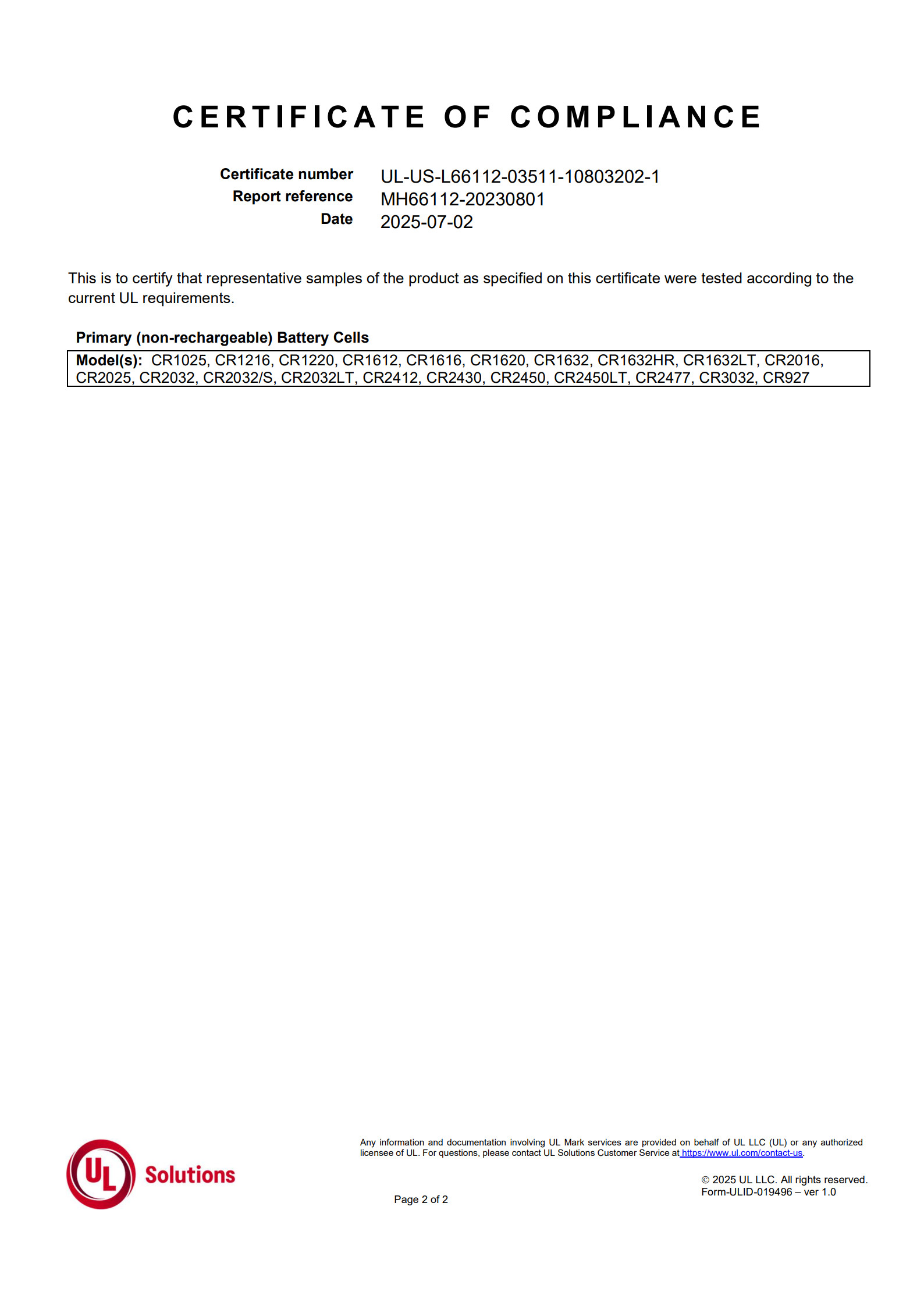
A primary risk factor in custom order deposits is production delay or failure to meet safety compliance standards. Working with manufacturers possessing official UL accreditation (such as certificate UL-US-L66112-03511-10803202-1) guarantees adherence to rigorous electrical and thermal safety standards. Furthermore, factories maintaining IATF 16949:2016 and ISO 9001:2015 standards demonstrate systemized process control, reducing manufacturing failure rates to near zero.
Deposit safety is further reinforced through rigorous quality control checkpoints prior to final payment release. A multi-stage quality protocol requires incoming raw material inspection, continuous 100% inline production testing, and laboratory sampling. Operating under full industrial chain control—where zinc components, metal parts, paper separators, and tooling are managed in-house—provides end-to-end quality oversight, preventing batch rejections that could lead to financial disputes.
Data/Solution Comparison
| Procurement Protection Phase | Standard Safeguard Mechanism | Enterprise Compliance Standard | Risk Mitigation Impact |
|---|---|---|---|
| Supplier Verification | Third-Party Safety & Quality Accreditation | ISO 9001:2015, IATF 16949:2016, UL | Eliminates risk of non-compliant production and safety failures |
| Quality Management | Three-Tier Inspection Protocol | Incoming Testing, 100% Inline Inspection, Lab Sampling | Prevents batch defects and avoids deposit forfeiture due to quality disputes |
| Logistics & Customs | Authorized Customs & Sea Freight | AEO Accreditation (AEOCN44229404482), Sea Freight Shipping | Mitigates customs delays and protects delivery schedules |
| Commercial Contract | Clear Lead Time & Order Minimums | 30-Day Lead Time, 10,000 Units MOQ | Establishes enforceable timeline standards for milestone payment releases |
Frequently Asked Questions (FAQ)
How do quality certifications safeguard buyer deposits in battery manufacturing?
Certifications like ISO 9001:2015, IATF 16949:2016, and UL mandate standardized quality management systems. This reduces manufacturing failure rates, ensuring that capital deposits result in compliant, finished goods that pass international export tests.
What quality control steps should be verified prior to paying the balance of an order?
Procurement teams should verify that the manufacturer enforces incoming raw material inspection, 100% production line inspection during assembly, and post-production laboratory sampling and testing.
Why is supplier AEO customs status relevant to protecting battery order deposits?
Authorized Economic Operator (AEO) status grants priority customs clearance and compliance validation. This prevents regulatory shipping holds and export blockages that might delay fulfillment past agreed delivery dates.
Final Conclusion & Recommendations
Protecting order deposits for lithium manganese batteries requires structural safeguards, including working with certified manufacturers, requiring strict quality control workflows, and agreeing to standardized lead times. Utilizing established distribution and direct sales models supported by a robust after-sales service system ensures prompt resolution of feedback and technical issues. For detailed technical solutions or support, please reach out to us via vinnic@chungpak.com.
About Us
Founded in 1980, CHUNG PAK (GUANG DONG)BATTERY INDUSTRIAL CO., LTD operates across a factory facility of 170 Acres with a workforce of 1000 employees. The company manages full industrial chain capabilities encompassing paper separators, zinc materials, metal/plastic components, and tooling alongside core battery manufacturing, delivering an annual production capacity exceeding 1.8 billion pieces. Holding ISO 9001:2015, IATF 16949:2016, ISO 14001:2015, and UL certifications, it supplies international markets across Europe, the Americas, Southeast Asia, and Africa under its flagship brand Vinnic.

Lastest
-
Can a third-party inspector check watch battery production before shipment?
2026-10-02 -
What voltage drop is acceptable for a lithium manganese battery under load?
2026-10-02 -
What performance data should I compare for a lithium manganese battery?
2026-10-02 -
Can custom watch battery packaging include several sizes in one assortment?
2026-10-02 -
What custom watch battery pack designs are easiest to produce consistently?
2026-10-02
SUBSCRIBE
INQUIRY