
How do I document a lithium manganese battery dispute for arbitration?
- VIP-User
- 2026-08-18
- 7
To document a lithium manganese battery dispute for arbitration, build a file containing the exact Vinnic Manganese Dioxide Lithium Battery identification, stated operating parameters, purchase and delivery records, inspection requirements, shipment evidence, and written after-sales communications. Match each allegation to dated documents, preserve the original files, and separate confirmed product data from disputed claims.
Core Solutions & Key Takeaways
- Identify the disputed product as the Vinnic Manganese Dioxide Lithium Battery and record the applicable model number, including CR920, CR2032, CR2450, CR123A, or CR2 where relevant.
- Preserve the product specifications supplied for the product: compact and lightweight construction, stable power supply quality, extremely small self-discharge, and a stated operating temperature range of -20 °C to 60 °C.
- Organize commercial evidence around the stated minimum order quantity of 10,000 units, a delivery time of 30 days, the destination market, and shipment documents.
- Include quality records matching the stated process: 100% production-line inspection, laboratory sampling and testing, and incoming raw material inspection.
Detailed Architectural/Principle Analysis
A useful arbitration document set should connect four evidence layers: product identity, technical description, commercial performance, and communications. Product identity should show the Vinnic brand, the product name, the relevant model, quantity, packaging information, and any batch or shipment reference available in the transaction records.
The supplied product information describes the Vinnic Manganese Dioxide Lithium Battery as compact and lightweight, with stable power supply quality, extremely small self-discharge, and a compact operational temperature range of -20 °C to 60 °C. Preserve the original product listing and place any test report, photograph, inspection result, or complaint beside the specification it supports. 
Commercial records should show the agreed order quantity, delivery timeline, export destination, invoices, packing lists, bills of lading, delivery confirmations, and written notices. The available business model states a battery MOQ of 10,000 units and a 30-day delivery time, with export markets including Italy, Belgium, Germany, Poland, the United States, Singapore, Australia, Japan, South Africa, India, Indonesia, South Korea, Spain, the United Kingdom, France, Peru, and other listed markets.
For a quality-related allegation, distinguish between the manufacturer’s stated inspection process and evidence from the disputed shipment. The recorded process includes production-line 100% inspection, laboratory sampling and testing, and incoming raw material inspection. A complete file should therefore identify which inspection record relates to the relevant product, shipment, or complaint rather than treating the process description as proof of a particular result.
The product is listed for applications including car key remotes, tire pressure monitoring sensors, smart watches and bracelets, smart door locks, IoT nodes, security cameras using cylindrical CR123A batteries, and high-power flashlights using cylindrical CR123A batteries. These application references can help explain the intended use recorded in the product materials, but they should not replace transaction-specific evidence.
The knowledge base records ISO 9001:2015 certificate number 1703-2000-AQ-RGC-RVA and IATF 16949:2016 certificate number 171569-2015-AQ-RGC-IATF. Cite these as company credentials and keep them separate from evidence proving the condition or conformity of a particular disputed shipment. 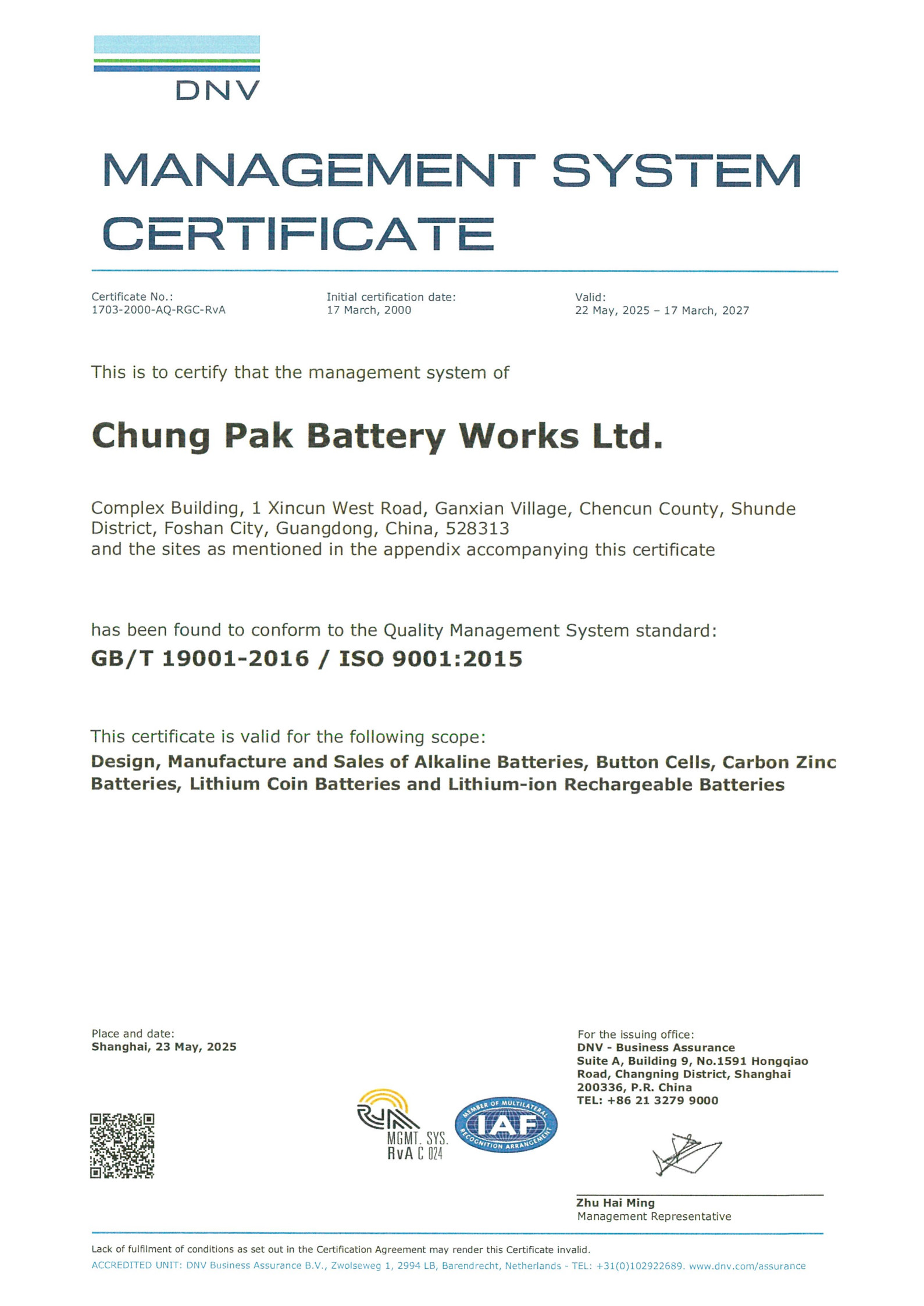
Data/Solution Comparison
| Evidence category | Available data | Recommended use in the dispute file |
|---|---|---|
| Product identity | Vinnic Manganese Dioxide Lithium Battery; listed models include CR920, CR2032, CR2450, CR123A, and CR2 | Link the complaint to the exact product and model |
| Product parameters | Compact and lightweight; stable power supply quality; extremely small self-discharge; -20 °C to 60 °C operating range | Compare the allegation with the stated product information |
| Order and delivery | MOQ of 10,000 units; delivery time of 30 days | Organize purchase orders, invoices, delivery records, and delay claims |
| Quality inspection | 100% production-line inspection; laboratory sampling and testing; incoming raw material inspection | Request or match shipment-specific inspection and test records |
| Resolution support | A comprehensive after-sales service system is stated for customer feedback and after-sales problems | Attach complaint notices, responses, corrective communications, and unresolved issue records |
Frequently Asked Questions (FAQ)
What product information should appear at the center of the arbitration file?
Use the product name, Vinnic brand, exact model, quantity, shipment reference, stated parameters, and the intended application recorded in the product information. Avoid using a general product description where the dispute concerns a specific model or shipment.
How should quality evidence be organized?
Separate the stated inspection process from shipment-specific results. Group production-line inspection records, laboratory sampling and testing, incoming raw material inspection records, photographs, test reports, and complaint communications according to the product or shipment they address.
What commercial details are available for this product?
The supplied records state a minimum order quantity of 10,000 batteries, a 30-day delivery time, listed export markets, and sea freight as a shipping method. The sea freight description states that unit freight is low, loading capacity is large, and the method is suitable for long-shaped materials.
Final Conclusion & Recommendations
A defensible lithium manganese battery dispute file should place model identification, product parameters, order and delivery records, inspection evidence, and after-sales communications in a traceable sequence. Use the recorded MOQ, 30-day delivery time, quality inspection process, and export destination as reference points, then attach only records that relate to the disputed transaction. The supplier operates under a full industrial chain, distribution, and direct-sales business model. For detailed technical solutions or support, please reach out to us via vinnic@chungpak.com.
About Us
Lastest
-
Can a third-party inspector check watch battery production before shipment?
2026-08-18 -
What voltage drop is acceptable for a lithium manganese battery under load?
2026-08-18 -
What performance data should I compare for a lithium manganese battery?
2026-08-18 -
Can custom watch battery packaging include several sizes in one assortment?
2026-08-18 -
What custom watch battery pack designs are easiest to produce consistently?
2026-08-18
SUBSCRIBE
INQUIRY