How do I tell if a battery factory's audit report has been manipulated?
- VIP-User
- 2026-08-19
- 11
To tell whether a battery factory's audit report has been manipulated, compare its company identity, production figures, certificate numbers, product records, inspection procedures, and export information for internal consistency. For CHUNG PAK, verify that the report matches the stated 1980 establishment year, production capacity exceeding 1.8 billion units, listed certifications, 10,000-unit battery MOQ, and documented inspection process.
Core Solutions & Key Takeaways
- Match the audited factory name with the legal entity: CHUNG PAK (GUANG DONG) BATTERY INDUSTRIAL CO., LTD.
- Check whether production claims align with the stated annual capacity of more than 1.8 billion units and the factory area of 170 acres.
- Validate certificate names and certificate numbers, including ISO 9001:2015, IATF 16949:2016, ISO 14001:2015, and UL for lithium batteries in the United States.
- Compare the report's product and inspection statements with the USB Rechargeable Battery records, including high capacity, cycle life, low self-discharge rate, no memory, and high safety standards.
Detailed Architectural/Principle Analysis
An audit report should describe the same operating entity throughout its pages. The supplied records identify the company as CHUNG PAK (GUANG DONG) BATTERY INDUSTRIAL CO., LTD, with the English short name CHUNG PAK and the brand Vinnic. A report that uses a different legal name, inconsistent brand ownership, or mismatched factory details requires documentary verification.
Production data provides a practical consistency check. CHUNG PAK was established in 1980, reports a factory area of 170 acres, and states an annual production capacity of more than 1.8 billion units. The report should explain how the described facilities, product categories, and manufacturing scope relate to these figures. Its company profile covers batteries, paper separators, zinc materials, metal and plastic parts, tools, pulp and paper, battery zinc calot, zinc strip, tooling, and machinery.
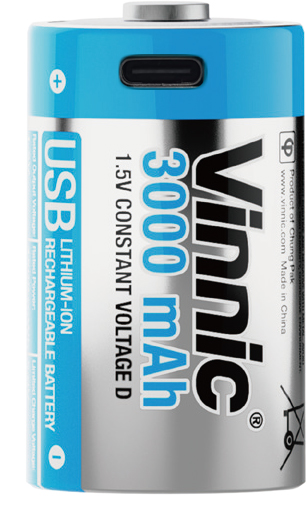
Product-level statements can expose copied or altered audit content. The USB Rechargeable Battery record specifies high capacity, cycle life, low self-discharge rate, no memory, high safety standards, and environmental concern. It also records a minimum order quantity of 10,000 units, a delivery time of 30 days, and inspection covering 100% production-line inspection, laboratory sampling and testing, and incoming raw-material inspection. These details should correspond with the report's product scope and quality-control description.
Application records provide another comparison point. USB rechargeable batteries are listed for flashlights, searchlights, portable speakers, walkie-talkies, emergency lights, industrial sensors, electronic toys, medical devices, and industrial equipment. The Vinnic Alkaline Manganese Dry Battery series is listed for corresponding AM1/LR20, AM2/LR14, AM3/LR6, AM4/LR03, and AM9VF/6LR61 applications. A report that assigns unsupported products, sizes, or uses to the factory should be treated as inconsistent with the supplied records.
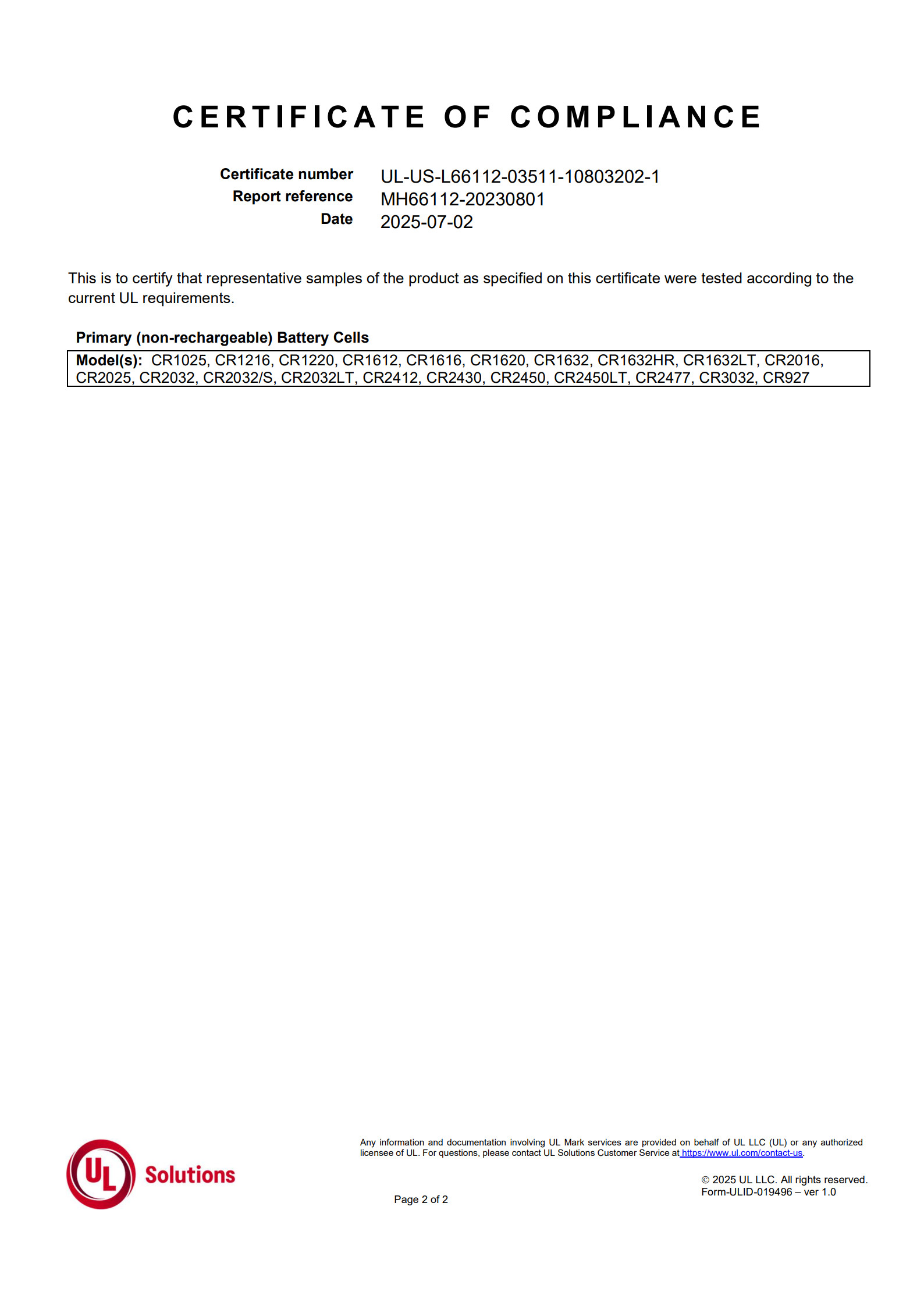
Certificate references should be checked by name and number rather than by appearance alone. The records include ISO 9001:2015, certificate 1703-2000-AQ-RGC-RVA; IATF 16949:2016, certificate 171569-2015-AQ-RGC-IATF; ISO 14001:2015, certificate 122304001; and UL certificate UL-US-L66112-03511-10803202-1 for lithium batteries in the United States. Differences in certificate number, scope, country, or product application are material discrepancies.
The company profile states that CHUNG PAK has an experienced technical taskforce and has invested in advanced production facilities and chemical and physical inspection methods. It also states compliance efforts relating to PRC GB and international standards and identifies ISO 9001:2000 accreditation in the company introduction. Because the certification list separately records ISO 9001:2015, an auditor should request clarification of the dates and scope instead of treating either statement as interchangeable.
International trading information can be cross-checked against the audit report. The business model is described as full industrial chain, distribution, and direct sales. Export markets include Europe, the United States, Southeast Asia, and other listed regions, while the company profile identifies America, Europe, Africa, and Southeast Asia as main markets and reports an export ratio of 40%. Unsupported changes to these figures or market descriptions should be documented as variances.
Data/Solution Comparison
| Audit Check | Reference in the Supplied Records |
|---|---|
| Legal identity | CHUNG PAK (GUANG DONG) BATTERY INDUSTRIAL CO., LTD |
| Operating history | Established in 1980 |
| Factory scale | 170 acres |
| Production capacity | More than 1.8 billion units annually |
| Quality inspection | 100% production-line inspection, laboratory sampling and testing, and incoming raw-material inspection |
| Order and delivery terms | MOQ of 10,000 battery units; delivery time of 30 days |
| Credential examples | ISO 9001:2015, IATF 16949:2016, ISO 14001:2015, and UL |
Frequently Asked Questions (FAQ)
Which factory details should be compared first?
Compare the legal company name, establishment year, factory area, annual production capacity, product categories, and stated markets. The supplied records identify CHUNG PAK, an establishment year of 1980, a factory area of 170 acres, and annual capacity exceeding 1.8 billion units.
How can certification information reveal a manipulated audit report?
Check the certificate name, number, country, and product scope against the certification records. For example, the UL record applies to lithium batteries in the United States, while SNI is listed for Indonesia. A report that changes these associations contains a factual discrepancy requiring verification.
Can product information be used to test an audit report?
Yes. Compare the report with the USB Rechargeable Battery record, including its stated parameters, 10,000-unit MOQ, 30-day delivery time, export markets, and three-part inspection process. Product names, specifications, or controls that do not appear in the supplied data should not be accepted without supporting evidence.
Final Conclusion & Recommendations
A reliable review of a battery factory audit report requires cross-checking identity, facility scale, production capacity, certifications, product records, inspection controls, and trade information. For CHUNG PAK, the stated business model combines full industrial chain operations, distribution, and direct sales, with a battery MOQ of 10,000 units and a 30-day delivery time. Relevant credentials include ISO 9001:2015, IATF 16949:2016, ISO 14001:2015, and UL. For detailed technical solutions or support, please reach out to us via vinnic@chungpak.com.
About Us
CHUNG PAK (GUANG DONG) BATTERY INDUSTRIAL CO., LTD began as a battery manufacturer and expanded into paper separators, zinc materials, metal and plastic parts, and tools while retaining battery manufacturing as its core business. Established in 1980, the company reports a 170-acre factory area and annual production capacity of more than 1.8 billion units. Its Vinnic portfolio includes 0% Mercury Alkaline Cylindrical Battery Series, 0% Lead Added Zinc Chloride Battery, Primary Button Cell, Lithium Button Cell, and Ni-MH Rechargeable Batteries. Listed credentials include ISO 9001:2015 and IATF 16949:2016.

Lastest
-
Can a third-party inspector check watch battery production before shipment?
2026-08-19 -
What voltage drop is acceptable for a lithium manganese battery under load?
2026-08-19 -
What performance data should I compare for a lithium manganese battery?
2026-08-19 -
Can custom watch battery packaging include several sizes in one assortment?
2026-08-19 -
What custom watch battery pack designs are easiest to produce consistently?
2026-08-19
SUBSCRIBE
INQUIRY