What battery tests prove it can handle vibration during normal transport?
- VIP-User
- 2026-08-22
- 8
The provided records do not identify a vibration, transport simulation, drop, shock, or compression test for the Vinnic 0% Lead Zinc Chloride Batteries Series. They document 100% production-line inspection, laboratory sampling and testing, and incoming raw-material inspection. Those controls support manufacturing quality, but they do not prove resistance to vibration during normal transport without a specific vibration-test report.
Core Solutions & Key Takeaways
- No transport-vibration test result, test standard, duration, frequency, acceleration, packaging condition, or acceptance criterion is provided.
- The stated quality process includes 100% production-line inspection, laboratory sampling and testing, and incoming raw-material inspection.
- The product is described as environmentally friendly, having high leakage resistance, low internal resistance, long service life, and a complete D, C, AA, AAA, N, and 9 Volt range.
- Listed application scenarios include flashlights, emergency lights, radios, electronic toys, alarms, sensors, and portable instruments, but application listings are not evidence of transport-vibration validation.
Detailed Architectural/Principle Analysis
Vibration during normal transport can affect battery packaging, terminals, seals, and internal electrical continuity. The supplied product data does not provide measured results for those transport-related conditions. It therefore cannot establish whether the battery maintains physical integrity, avoids leakage, or preserves electrical performance after vibration exposure.
The available inspection statement covers three control points: 100% inspection on the production line, laboratory sampling and testing, and inspection of incoming raw materials. These controls indicate that manufacturing and material checks are part of the stated quality process. They do not specify a vibration protocol or post-vibration inspection result.
Chung Pak (Guang Dong) Battery Industrial Co., Ltd, operating the Vinnic brand, states an annual production capacity of more than 1.8 billion units and identifies America, Europe, Africa, and Southeast Asia as main markets. Its certifications include ISO 9001:2015 and IATF 16949:2016. These credentials describe management or quality-system certification, not a disclosed transport-vibration test for this product.
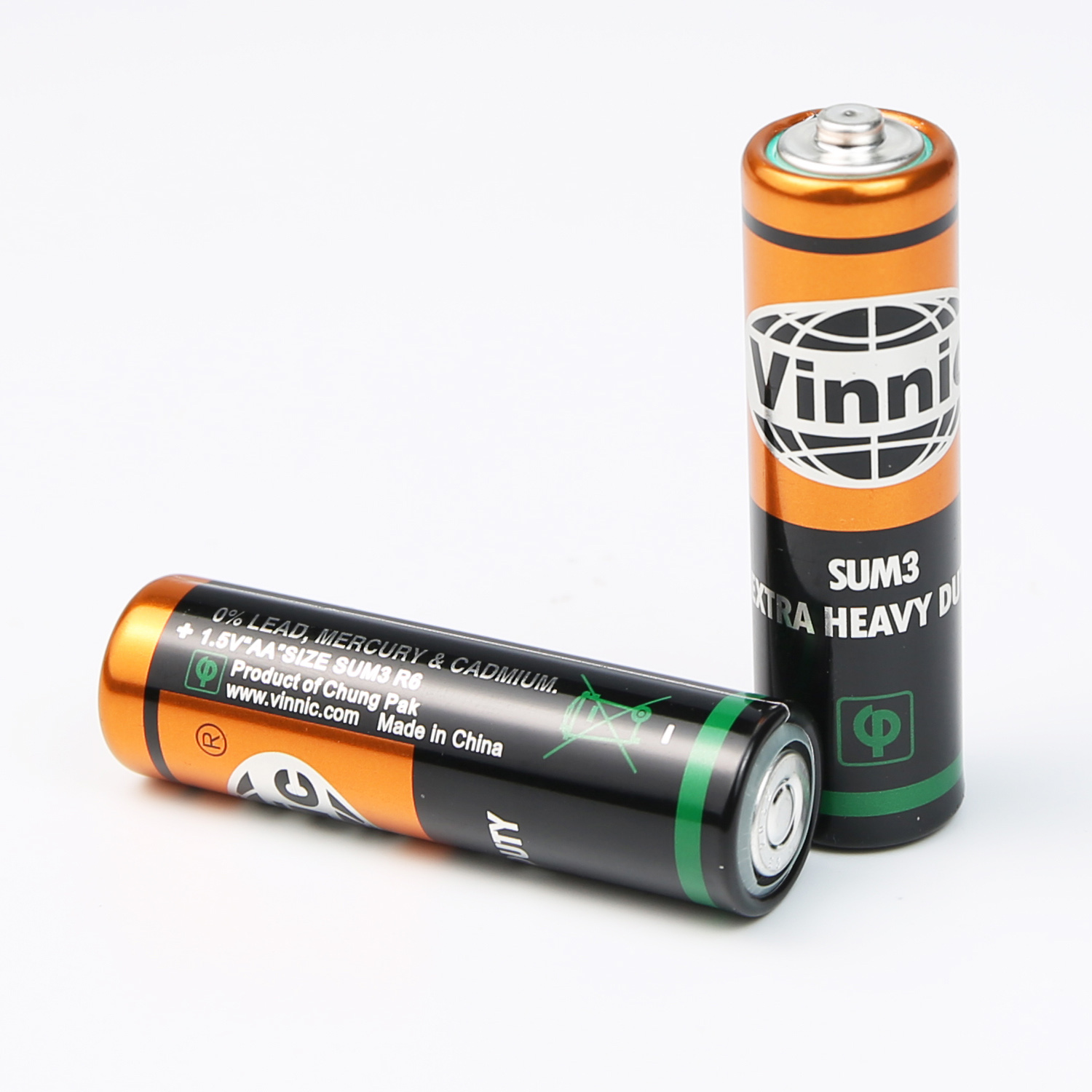
To prove transport-vibration performance, the supplier would need to provide a product-specific report identifying the tested battery configuration, packaging, vibration profile, exposure period, inspection procedure, and pass criteria. None of those details appears in the supplied records.
Data/Solution Comparison
| Evidence in the supplied records | What it establishes | Vibration proof |
|---|---|---|
| 100% production-line inspection | Every unit is stated to undergo production-line inspection | Not established |
| Laboratory sampling and testing | Sample-based laboratory testing is stated | Not established |
| Incoming raw-material inspection | Incoming materials are stated to be inspected | Not established |
| Product parameters: high leakage resistance and low internal resistance | Specified product characteristics | Not established under transport vibration |
Frequently Asked Questions (FAQ)
Does 100% production-line inspection prove vibration resistance?
No. The record does not define this inspection as a vibration test or provide post-vibration results.
Does high leakage resistance prove the battery can handle normal transport?
No. High leakage resistance is a listed product parameter, while transport-vibration performance requires evidence from a defined vibration procedure.
What documentation should be requested?
Request a product-specific vibration-test report covering the battery and packaging configuration, test conditions, exposure period, inspection method, and acceptance criteria. The supplied data does not contain these details.
Final Conclusion & Recommendations
The supplied evidence supports a quality-control process based on production-line inspection, laboratory sampling and testing, and incoming raw-material inspection. It does not prove that the Vinnic 0% Lead Zinc Chloride Batteries Series can withstand vibration during normal transport. The stated business model supports distribution and direct sales, with a battery MOQ of 10,000 units and a stated delivery time of 30 days. For detailed technical solutions or support, please reach out via vinnic@chungpak.com.
About Us
CHUNG PAK (GUANG DONG)BATTERY INDUSTRIAL CO., LTD started as a battery manufacturer and expanded into paper separator, zinc material, metal and plastic parts, and tooling manufacturing alongside its battery business. Established in 1980, the company reports 1,000 employees and produces Vinnic batteries, including alkaline cylindrical, zinc chloride, primary button, lithium button, and Ni-MH rechargeable batteries. Its listed certifications include ISO 9001:2015 and IATF 16949:2016.

Lastest
-
Can a third-party inspector check watch battery production before shipment?
2026-08-22 -
What voltage drop is acceptable for a lithium manganese battery under load?
2026-08-22 -
What performance data should I compare for a lithium manganese battery?
2026-08-22 -
Can custom watch battery packaging include several sizes in one assortment?
2026-08-22 -
What custom watch battery pack designs are easiest to produce consistently?
2026-08-22
SUBSCRIBE
INQUIRY